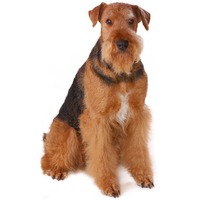
Airedale Terrier
Airedale, King of Terriers, Waterside Terrier, Bingley Terrier




Breed history:
This breed looks very much like the Norwich Terrier, the main difference is the ears. They were recognized as different breeds in 1964. It is one of the smallest working terriers and was raised to hunt rats and foxes.
Description:
It is a small-sized dog, with strong legs and a short, strong body. It has a broad and rounded head, with a strong, trapezoidal muzzle that is shorter than the skull. The eyes are small, egg-shaped, set apart and dark. The ears are drooping, slightly rounded at the tip and medium-sized. The tail is short, straight and carried vertically. The fur is double-layered, with an outer layer made of wiry, hard, smooth hair, of 3-5 cm long, longer on the neck and shoulders, where it forms a sort of mane. The hair on the head and ears is shorter than on the rest of the body. The eyebrows and moustache are of medium length. The coat can come in all shades of red, straw yellow, black with brown, with or without small white patches.
Personality:
It is a lively, dynamic, brave, careful, intelligent, daring, friendly, firm and kind dog but can also be stubborn. It is affectionate and devoted to its master, it has no problems with children or with dogs or other household animals. Strangers are announced by barking after which it will calm down.
Grooming:
The hair must be brushed, combed regularly and should be trimmed 2-3 times per year.
Living conditions:
It is a dog that can easily adapt to the offered living conditions: in the open or in a flat, depending on its master - more active or less active. It needs socialization and training.
Training:
This dog learns pretty easily and no special problems will appear in the training if it is consistent, firm, well-balanced, without being harsh or cruel. It likes walks and digging.
Usefulness:
It is rarely used to hunt small animals and more used as a companion dog.
Airedale, King of Terriers, Waterside Terrier, Bingley Terrier


American Staffordshire Terrier, American Stafforshire Bull Terrier
